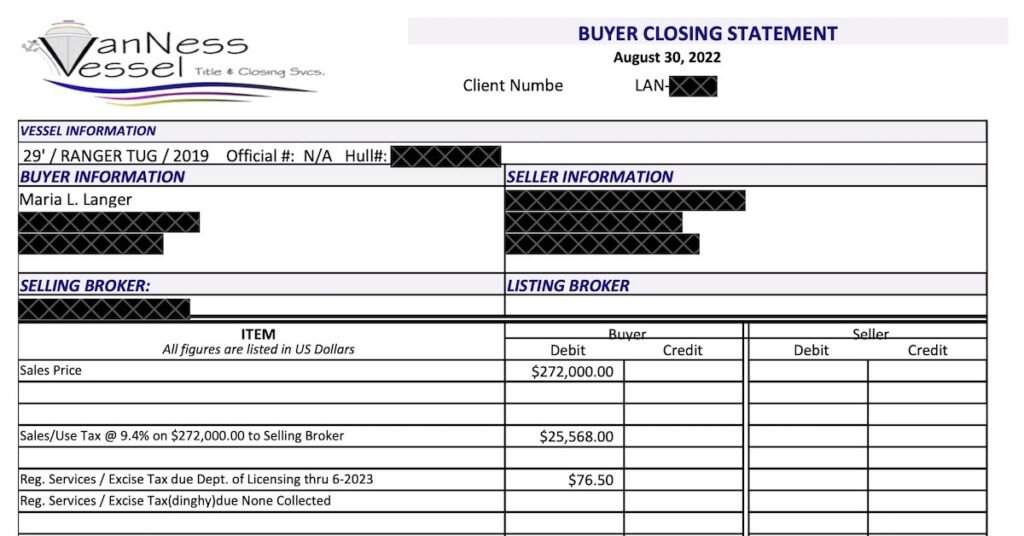
A lot of the costs of buying a boat are not obvious. But they’re not hidden unless you have no idea that they exist.
Part 1: Why I’m Blogging about This
Part 2: The Cost of Buying a Boat
Part 3: Responsibilities of Boat Ownership
In the previous post of this series, I explained what prompted me to write this series and introduced someone with a real life purchase decision to make. Here’s what I told her to help her make an informed decision.
Agreed Upon Price
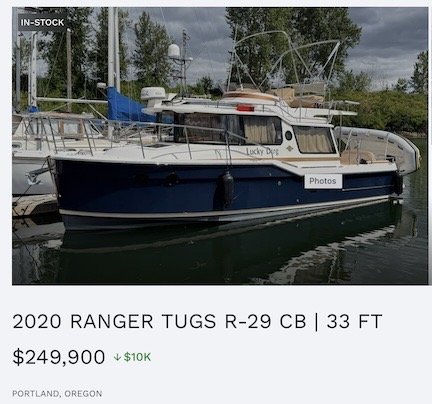
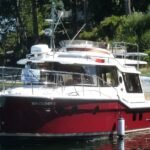
This is the closest one I could find to mine on YachtWorld today. The asking price is not set in stone; this one has already been dropped $10K. (It’s a buyer’s market!)
Every boat — like any other item you can buy, large or small — has a price. You’ll see it in the listing. It’s usually not set in stone, but don’t think the average seller will knock 17% right off the top when you show the least amount of interest in it. Yes, this is currently a buyer’s market, but this kind of discount before you even see the boat is very unusual.
If the boat isn’t near to you and you think there’s a pretty good chance you will buy it, you’ll do some haggling, come up with an agreed-upon price contingent on the results of a professional survey and sea-trial, and enter into a contract that’s going to require a security deposit to hold the boat for you. All this applied to me when I bought my boat in late summer 2022. It looked like the right boat and the owner budged just enough on his price for it to fit into my budget. I sent a 10% deposit — $27,000, if I recall — with the understanding that if it turned out to be wrong for me or the survey uncovered serious problems, I’d get that money back or could re-negotiate.
If the boat is near enough to you to look at it before you agree on a price, great! You should have a much better idea of whether the boat is for you before doing the haggling and entering into a contract. It’s pretty certain that they’ll want a deposit, though.
The Survey
The survey costs money. You should find a boat surveyor who is not recommended by the seller’s broker. Someone who is certified to do this work. You might want to call a local Yacht Club or Marina to get some names. The surveyor makes an appointment to come see the boat.
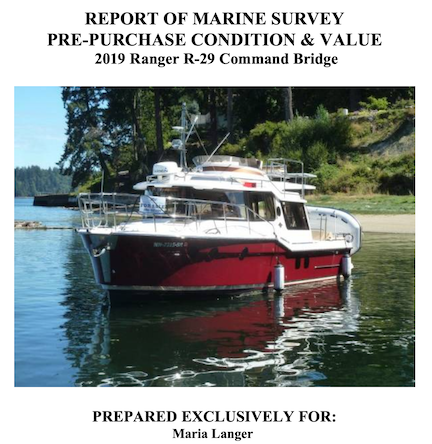
The survey for my boat was almost 50 pages long. The surveyor had an easy job — although the boat was only 3 years old, it had just 29 hours on the engine. Still, the survey, including the sea trial, cost $1,200.
Someone — usually the broker — arranges to have it pulled out of the water, hauled up on land, power-washed (if necessary), have its hull inspected, and later put back in the water. This might be done at the same marina, if they’re properly equipped, or the boat might need to be driven to another marina. If the boat is already out of the water — maybe it’s stored on the hard — it needs to be put in for the sea trial when the bottom inspection is done.
When I bought my boat, the inspection cost $1200. I think I paid another $400 or so to have it hauled out, washed, and put back into the water after the inspection. This is money out of my pocket that I would have to pay whether I bought the boat or not.
If possible, be on hand for the survey. Although you might not get a chance to actually drive the boat, you can talk to the inspector about things he sees or you see. Since the broker will probably also be present, you can talk to him/her, too. One boat I looked at that I did not buy had the owner on board, too. It didn’t get awkward, but he did give me some insight to the boat. It was a good boat but the wrong time for me to buy.
Do not skip the survey! Unless you are prepared to take a total loss on a boat that might not even be seaworthy, you should always get the boat surveyed before you buy it. After all, these boats are not cheap. Hell, mine cost more than my first two houses and is pretty darn close to the cost of the one I’m living in now. Would you buy a house without an inspection? Of course not! And rest assured that no lender will lend you a dime without a survey by a qualified surveyor. This is not the time to get cheap. Be sure to get a full survey, including a sea trial. You want that engine running with a surveyor taking notes.
Closing Costs
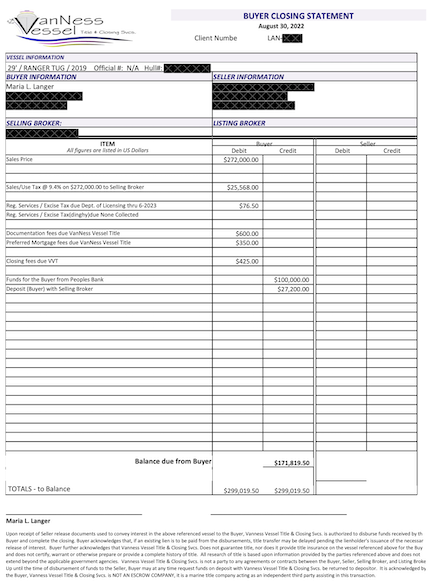
The closing document for my boat. This does not include fees to the lender, the survey, or insurance, which I needed before the lender would wire the money to the title company.
Okay, so now you have settled on a price and want to move forward with the purchase. Considered this closing costs that might apply:
- Lenders fees. Application, credit check, wire transfer. Who knows what else? This could add up to $150 to $1000 depending on the lender.
- Title fees. In Washington State, a title company is involved with the transfer of ownership of a boat. They have fees that could add up to a few hundred dollars.
- Sales tax. Did you know you have to pay sales tax on the purchase of a new boat in most (but yes, not all) states? Sara didn’t. This is the biggest “hidden cost” of buying a boat. And to get the boat registered, sales taxes must be paid in full.
- License and registration fees. Eventually, the boat will need to be registered in the state in which it lives. Some states charge more than others.
- Documentation fees. If you plan to get the boat documented with the USCG (if it isn’t already), you’ll have to apply for that and pay a fee.
- Insurance. The boat will need to have insurance coverage, especially if you have a lender. I put this with closing costs because you’ll likely have to pay for it around the same time you complete the purchase.
I’m sure I left something out here. Your lender or the boat broker should be able to give you a good estimate of what you can expect to pay before you drive off in your new boat.
I think the purchase price of my boat was $272,000. By the time all those fees were added up, I had a total outlay of just under $300,000. Ouch! Sara’s boat was a lot less, but she didn’t realize that she have most of these costs on top of that purchase price. I bet her total cost for that $190,000 boat would come in around $210,000.
Outfitting
Whether the boat is new or used, you may have to acquire items to fully outfit it. Think about lines and fenders for the outside. Think about linens, dishes, pots, and pans. Think about chart books and chartplotter updates. Think about all of the things you need to make the boat ready to take out on the water.
Some boats come with many of these things. In my experience, a lot of them are crap. The previous owner bought or plans to buy another boat and he pulls all the best stuff off the boat you bought, replacing them with the junk from the previous owner of his new boat. I was on a 2024 Antares 11 last summer and I swear that the previous owner had gone through his collection of lines and put every crappy one he had on that boat for my client.
What else? Lots!
This is just an idea of the kinds of cost you’ll face when acquiring the boat and getting it ready to cruise. But the costs and responsibilities don’t end her. In the next (and last) part of this series, I’ll tell you more about your responsibilities as a boat owner.
This article was very informative. I had no idea on the extra costs that are involved when purchasing a larger boat.
It’s a lot like buying a house! The cost, the expenses, using a title company, having brokers involved, getting a survey.